Megaways Slots Not on GamStop
Best Non GamStop Casino UK 2026
Loading...
Megaways Slots on Non-GamStop Sites
Megaways changed the slot grid — and non-GamStop sites have every title. That sentence is both the pitch and the reality. The mechanic, licensed from Big Time Gaming, introduced variable reel sizes that reshuffle on every spin, creating anywhere from a few hundred to over 100,000 possible ways to win on a single round. It was novel when it launched. It became a standard when every major provider paid to license the system and apply it to their own franchises.
For UK players on non-GamStop platforms, the appeal is straightforward. UKGC-regulated sites carry Megaways titles but operate them under restrictions that alter the experience: slower spin speeds, no autoplay, and stake caps that limit how much you can wager per round. Non-GamStop sites running offshore licences remove those constraints. The same Megaways engine runs at full speed with no bet ceiling, autoplay intact, and — in many cases — the bonus buy feature unlocked. Whether those freedoms are a net positive depends entirely on the player, but the mechanical difference is concrete.
This guide breaks down how the Megaways system actually works under the surface, which titles are worth attention on non-GamStop platforms, and why the mechanic continues to attract players years after the initial hype should have worn off.
How the Megaways Mechanic Works
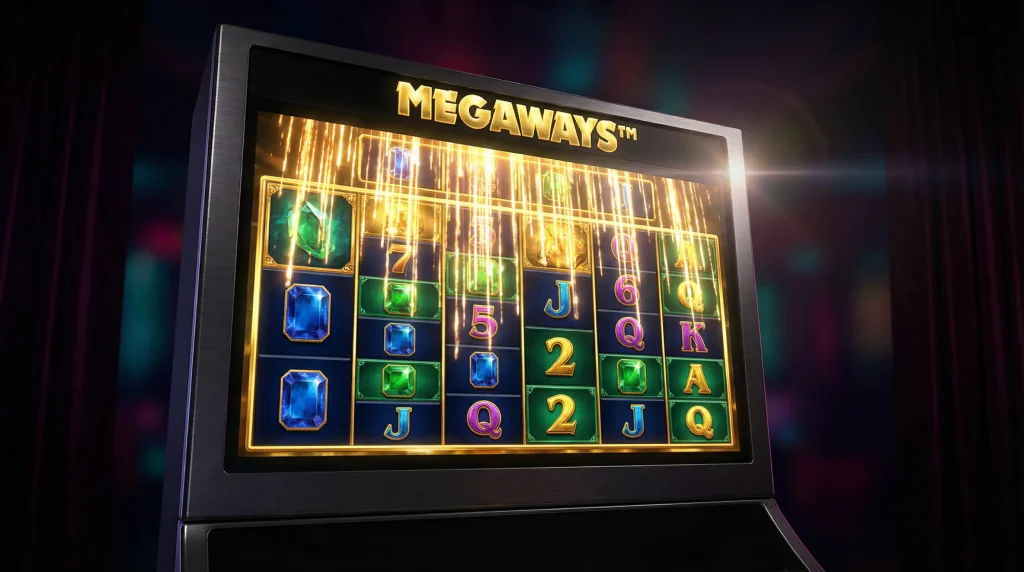
Each spin reshuffles the reel height — and the payline count with it. That is the core innovation. Traditional video slots use a fixed grid, typically five reels with three rows, producing a set number of paylines — say 20 or 50. Megaways replaces the fixed row count with a random modifier. Each reel can display between two and seven symbols per spin, and the total number of ways to win is the product of all reel heights multiplied together.
On a six-reel Megaways slot, if every reel shows its maximum of seven symbols, you get 7 x 7 x 7 x 7 x 7 x 7 = 117,649 ways to win. If the reels land short — say, three symbols on each — you get 729. The variance between those two extremes is what gives Megaways its distinctive rhythm. One spin feels quiet, the next one opens up the grid like a warehouse door. It is a fundamentally different relationship with the payline concept, and it produces session profiles that traditional fixed-line slots cannot replicate.
Most Megaways titles also incorporate a cascading wins system, often called tumbling or avalanche reels depending on the provider’s branding. When a winning combination lands, the winning symbols are removed from the grid and new symbols fall into the empty positions. If the new arrangement creates another win, the cascade continues. Some games attach increasing multipliers to each consecutive cascade within the same spin, which is where the mechanic’s real payout potential lives. A base game spin that triggers four or five cascades with a climbing multiplier can produce returns far beyond what a single payline hit would deliver.
The bonus round in most Megaways slots amplifies this structure. Free spins typically carry an unlimited win multiplier that does not reset between spins — it only goes up with each cascade. A twelve-spin bonus round on a game like Bonanza Megaways or Gonzo’s Quest Megaways can build a multiplier into double or triple digits, which is precisely why these games appeal to players chasing volatile, high-ceiling outcomes. The maths is aggressive. The upside is real but infrequent, and the base game can be brutally dry between bonus triggers.
Best Megaways Slots on Non-GamStop Sites
These are the Megaways titles that draw the most traffic on offshore platforms — and for good reason. Each one uses the variable grid system differently, and the distinction matters if you are choosing based on volatility, bonus structure, or simply personal preference for how the game feels during a session.
Big Time Gaming’s Bonanza Megaways is the original and still one of the most played. Six reels plus a horizontal top reel push the maximum way count to its theoretical ceiling, with cascading wins, an unlimited multiplier in free spins, and an RTP around 96.0% at the highest tier. The game’s volatility is high by any measure. Base game stretches without a bonus trigger can be long, but when the free spins round connects, the multiplier climbs fast. On non-GamStop sites, Bonanza is almost universally available and typically carries the bonus buy option that UKGC platforms are required to block.
Pragmatic Play adapted the mechanic across a wide portfolio. Gates of Olympus, while technically not a traditional Megaways title by licence, uses a similar all-ways-pay system with tumbling wins and multiplier orbs. Its actual Megaways-branded entries include Great Rhino Megaways and Big Bass Bonanza Megaways, both of which perform well on non-GamStop sites. Pragmatic’s approach tends toward slightly lower volatility than Big Time Gaming’s core titles, making them a more forgiving option for players who want the dynamic grid without the extreme drought cycles.
Red Tiger’s Gonzo’s Quest Megaways took the classic NetEnt franchise and rebuilt it on the Megaways engine. The result is a game with strong brand recognition, cascading wins, and an earthquake feature that can expand the grid mid-spin. Its RTP lands around 96.0%, and the bonus round includes an escalating multiplier system — reaching up to 15x during free falls — that rewards consecutive cascading wins with progressively larger payouts, adding a layer of strategic tension that most Megaways titles lack.
iSoftBet’s Aztec Gold Megaways and Blueprint Gaming’s Eye of Horus Megaways both sit in the mid-volatility range with strong presence on non-GamStop platforms. Blueprint in particular was an early adopter of the Megaways licence and produced a deep catalogue of titles, some of which — like Fishin’ Frenzy Megaways — became staples in the UK market. On offshore sites, these games typically appear alongside their original fixed-line versions, giving players the option to compare mechanics side by side.
What separates the best Megaways slots from the forgettable ones is not the payline count. Every Megaways title reaches the same theoretical maximum. The difference lies in bonus design, cascade multiplier structure, hit frequency in the base game, and the relationship between volatility and RTP. A Megaways game with a high RTP but punishing volatility plays very differently from one with a moderate RTP and frequent small wins. Knowing which profile suits your bankroll and your patience is more useful than chasing the largest grid.
Beyond the Grid — Why Megaways Endures
The mechanic survived the hype cycle because it delivers real variance. That sounds simple, but it is the entire explanation. Slot players who gravitate toward Megaways are not doing so because the marketing is clever or because the visual design is superior — plenty of traditional slots look and sound better. They come back because the variable grid produces sessions that feel genuinely unpredictable in a way that fixed-line slots, by design, cannot match.
Every spin on a Megaways slot is a minor event. The grid expands or contracts, the cascade chain either builds or dies immediately, and the multiplier either climbs or stays flat. There is a narrative arc to every sequence, even if that arc lasts only two seconds. Fixed-line slots deliver outcomes. Megaways slots deliver sequences. That structural difference keeps the format relevant even as the industry moves toward newer mechanics like cluster pays and expanding grids.
On non-GamStop platforms, Megaways titles benefit from the absence of UKGC gameplay restrictions. Autoplay lets players set extended sessions without manual intervention. Bonus buy features allow direct access to the free spins round for a premium, typically between 80x and 100x the base bet. And unrestricted spin speed means the cascade animations play out at the pace the provider intended rather than the slowed-down version mandated by UK regulation. None of these features change the underlying mathematics. They change the experience — and for many players, that is the point.