
Monopoly Live Casino UK: Format and Key Checks
 Available in GB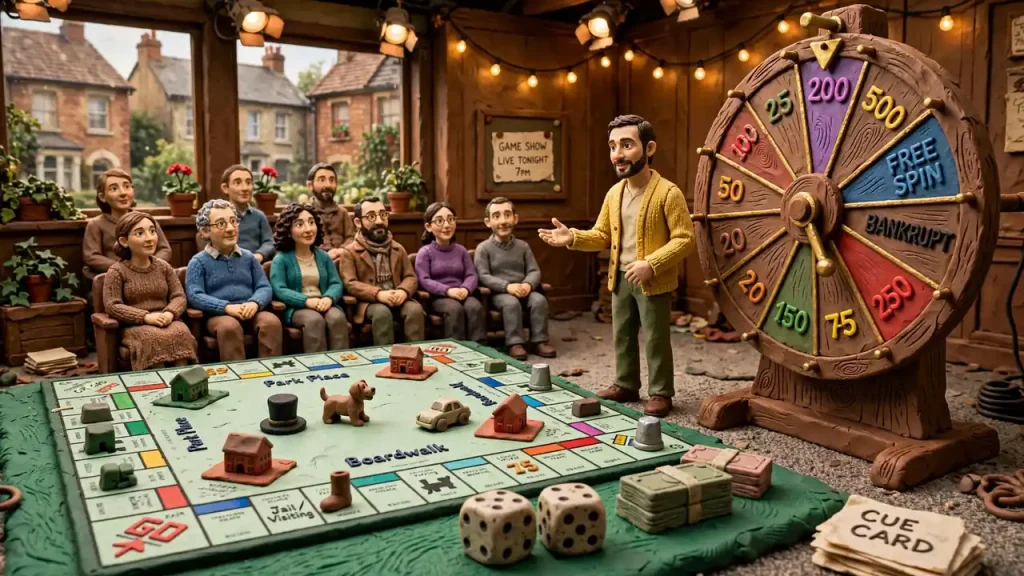
Monopoly Live uses a presenter and physical set in a live stream, with guidance on licensing, free play and the limits of tracking results.
What Monopoly Live Is—and What It Isn’t
Monopoly Live is a live casino game-show title built around the familiar Monopoly theme. You watch a presenter and a physical set through a live video stream, rather than play a conventional computer-generated slot. The board-game styling is part of the presentation; it does not make the game a digital version of a full Monopoly board game.
That distinction matters when you are deciding what you are looking at. A live game can share the bright graphics and quick, event-led feel of a slot without being a slot in the regulatory sense. Nor does the word “casino” in a game’s name settle its classification. The relevant question is what kind of gambling product it is, not whether the screen has a wheel, cards or familiar branding.
Monopoly Live is best understood first as entertainment delivered in a live casino format. The game’s visual theme may suggest a board-game journey, but you are not moving freely around a board or choosing a strategy for a property portfolio. You participate in the game presented on screen under the rules shown by the operator. The theme is decoration and context, not a change to the basic nature of gambling.
The difference from roulette and blackjack
Roulette and blackjack are recognisable casino games with their own established formats: roulette centres on a wheel and where its result lands, while blackjack is a card game in which decisions are made against the dealer. Monopoly Live is presented as a game show, so it should not be mistaken for either simply because it appears in a live casino lobby.
Online European Roulette Casinos in the UK: What to Check
The distinction also matters when people talk about stake limits. A specialist review describes Great Britain’s online slot limits as a maximum of £5 for each game cycle for adults aged 25 or older, and £2 for adults aged 18 to 24. The same review distinguishes roulette and blackjack from slots for this purpose, saying those slot limits do not apply to those two games.
That is a description of the rules for slots and the named casino games; it is not a shortcut for classifying every live title. Don’t infer that Monopoly Live is covered by a slot limit—or exempt from it—just by comparing its screen with roulette or blackjack. Check how the operator identifies the product and what its rules say. A live feed alone does not answer that question.
This is where the terminology can trip you up. “Live casino” describes how the game is delivered: a real presenter and set are streamed to your device. “Slot” describes a product category. Those labels are not interchangeable. A title can feel lively and game-show-like while still requiring you to look carefully at its actual product classification before making assumptions about applicable rules.
Online bingo in the UK: games, slots and play
Theme versus game
The Monopoly name gives the show a recognisable visual language, but the name is not a promise that the original board game’s choices or pacing have been reproduced. If you arrive expecting to buy properties, negotiate with other players or plan a long route around a board, you are looking at the wrong kind of experience. This is a casino game built for a live broadcast.
That also explains why “Monopoly casino live” and “live Monopoly casino” can sound like descriptions of a table game, even though the title is framed as a show. The operator’s game information is the useful place to check the format, rules and any product category stated for that version. A familiar logo is not a rulebook.
The live element can make the experience feel less like watching symbols spin on a screen. There is a presenter, a set and a broadcast, with the game unfolding in front of you. But the social, theatrical presentation should not be confused with control over the result. Watching a host explain or reveal an outcome does not make the game a skill contest or turn it into a conventional board-game session.
If you are comparing Monopoly Live with roulette or blackjack, compare like with like: the rules, the way a round works, and the classification the operator gives the game. Don’t use the general label “live casino” to assume that all titles share the same limits or mechanics. The label tells you about the stream; it does not, by itself, tell you which rules apply.
DO
- Check the operator’s classification and rules for the specific product.
- Use the operator’s own lobby and game information.
- Set a financial limit before you start playing.
DON’T
- Assume a title is a slot just because it has bright graphics.
- Use the general label “live casino” to assume all titles share the same limits.
- Infer product classification based on visual branding alone.
For me, that is the cleanest way to approach the title: recognise it as a themed live game show, then read its own information rather than letting the Monopoly branding do the explaining. And whatever format you choose, only gamble what you can afford to lose. The show is still gambling.
Best casino sites in the UK
- ChanzeBonus: Slots Welcome Bonus #1 200% up to €500 · Payout speed: 1-3 business days
- BritsinoBonus: Welcome Package – Get your £2,200 + 2,000 FS · Payout speed: 1-3 business days
- DieselwinBonus: Welcome Pack 250% up to £4000 + 200 FS · Payout speed: 1-3 business days
- NightWinBonus: £900 + 400 free spins · Payout speed: 1-3 business days
- x3betBonus: Welcome Pack 100% Up to £1.000 + 200 Free Spins · Payout speed: 1-3 business days
- BeOnBetBonus: 100% up to €500 + 100 FS · Payout speed: 1-3 business days
Playing Monopoly Live Online in Britain
To play Monopoly Live online, start with an operator licensed to serve customers in Great Britain. The UK Gambling Commission regulates gambling here, including online casinos, and remote operators serving British customers must hold the relevant licence. That is the starting point, not a badge to assume from a familiar name or polished site.
Before opening an account, read the operator’s terms and make sure you are comfortable with how it handles deposits, withdrawals and account controls. Then complete registration using accurate details. The operator must verify your age before it lets you deposit. Online gambling is for adults aged eighteen and over, so expect an age check rather than a route around one.
Once your account is set up, look for the casino’s live-games area and search its game list for Monopoly Live. Availability and the way a game is presented can vary by operator, so follow the site’s own lobby rather than relying on an old bookmark. Open the title only after checking that you have selected the real-money game you intend to play. Live casino interfaces can place several tables or versions close together; a quick glance at the title and table information saves a needless detour.
Live Casino in the UK: Games, Rules and Table Play
Before your first deposit, the operator must prompt you to set a financial limit. Take that step seriously: choose a boundary that fits your own budget, then check where the account-level controls are so you can review or change limits later. It is easier to make a considered choice before money is in the account than while a session is underway. Only wager what you can afford to lose.
Payment options also have rules. UK-licensed casinos cannot accept credit cards for gambling, and operators must not accept credit-card payments routed through a money service business. They also cannot accept a wallet payment if that wallet lets you use credit-card funds for gambling. If a payment method is declined, do not try to disguise its source; use an allowed method in your own name and follow the operator’s instructions.
After depositing, return to the live lobby, choose Monopoly Live and read the on-screen information before joining a table. Check the stake selection and any available table rules, then decide whether to proceed. Keep your limit in view during play. If you feel you are chasing losses or spending more than planned, leave the game and use the account controls rather than treating another round as a way to recover money.
The practical route is straightforward: register, pass the age check, set your limit, use an accepted payment method and open the live title from the operator’s lobby. The important part is doing each step deliberately. A licensed operator is required for remote gambling offered to customers in Great Britain; a convenient sign-up is no substitute for checking where you are playing.
Online gambling is for adults aged eighteen and over; expect an age check before you can deposit.
Checking a Casino’s Licence Before You Join
Before you put money into a site advertising Monopoly Live, check its operator against the UK Gambling Commission’s public register. A familiar logo or a polished page is not proof of a licence. I would start with the legal company name and the website address, then make sure the register entry connects them to the casino you intend to use.
The Commission regulates remote gambling offered to consumers in Great Britain even when the operator’s key equipment is based elsewhere. It is the sole regulator for commercial gambling in Great Britain. A company cannot avoid the relevant requirements simply by hosting its systems abroad.
What to match on the register
Look for an operating licence held by the business, rather than assuming that any entry with a similar name is enough. The Commission issues operating licences to businesses and personal licences to individuals working in the industry; those are not interchangeable. For a casino account, the important check is whether the business behind the site holds the appropriate operating licence for its gambling services.
Compare the entry with the details shown on the casino’s own terms or legal information page. Check the company name, trading name and domain, including the spelling of the address you are visiting. A licence belonging to a similarly named business does not establish that the site in front of you is covered. Watch for small differences in domains or branding; they can matter.
Then check the licence record itself. Make sure it is current and that the licensed activities are relevant to the service being offered. Do not treat a search result, a badge in a page footer or a copied licence number as a substitute for checking the Commission’s register directly. If a site gives a licence number, search for that number and see whether the record leads back to the same operator and domain.
Mines Casino Game UK: Rules, Risk and Free Play
If the company details do not line up, pause. Contact the operator through its published support route and ask it to explain the discrepancy before you create an account or deposit. If the explanation is unclear, or the register does not support the claim, choose a different site. A licence badge is easy to display; the register is where you verify what it represents.
Why the check matters
For consumers in Great Britain, remote operators must hold the relevant Gambling Commission licence. A casino that says its equipment is overseas is not exempt on that basis. Nor does a licence from another country replace the British authorisation required to offer remote gambling to people here.
This is a practical check, not a guarantee that every experience with a licensed operator will be trouble-free. UK-licensed operators must provide an internal complaints process and access to an approved Alternative Dispute Resolution service, but you should still read the site’s terms and know how to raise a complaint. Keep a record of the operator’s legal name and the register entry you checked, so you can refer back to them if needed.
The same care applies when a site promotes itself as one of the Monopoly Live casinos. The game title does not tell you who operates the casino or whether that business is authorised. Check the operator, not just the game page.
And keep the money side plain: only gamble what you can afford to lose. If the licence details are hard to verify, there is no good reason to rush past that warning sign.
How to Try the Game Without Depositing
If you want to see how Monopoly Live plays before risking money, look for a clearly labelled demo or free-play option. Do not assume it is available just because a casino lists the game. The operator decides what access it provides, and the version you can open may depend on whether you are signed in, which device you use, or the way the game is presented on its site.
Online Keno Casinos in the UK: How to Choose
I would start on the game’s own page at the casino, rather than following an old link or relying on a search result. Look for wording such as “demo”, “play for free” or “fun mode”. If the page shows only a real-money play button, that is not evidence of a free version tucked away somewhere. Check the operator’s help pages or ask its customer support whether it offers non-wagering access. A clear answer is better than guessing.
What a demo can show
A demo can help you get used to the screen and see how the game is presented without staking your own money. It may let you observe the pace, follow the on-screen instructions and understand where the available choices appear. That is useful if you have never opened this kind of live casino game before.
Treat it as a way to familiarise yourself with the interface, not as a test that tells you how real-money play will turn out. A free version cannot promise that the same experience or outcomes will follow when you wager. Nor does a run of results in a demo establish what will happen next. Keep the distinction simple: you are looking at how the game works on screen, not finding a reliable route to a future result.
Some operators may offer no demo at all. Others may provide a version that works only within their website or app, or after you have created an account. Read the wording on the page carefully: “free” can refer to a promotional offer with conditions, rather than a mode that lets you explore without staking. If the terms are unclear, ask before proceeding.
Checking free access on a phone
The same caution applies if you are looking for a Monopoly Live app. A casino may make its games available through a mobile browser, an app, or both; the presence of an app does not by itself mean the game has a free mode. Open the operator’s official game page from the device you plan to use and check what options are actually displayed there.
Online Casinos Without ID in the UK: What to Know
If you find a demo button, confirm that selecting it does not take you into a real-money game or ask you to make a deposit to continue. A sign-in prompt is not automatically a request to wager, but it does mean the operator’s free access has a condition. Decide whether you are comfortable with that before entering account details. Avoid unofficial downloads or links from unfamiliar pages; they can leave you unsure who is providing the game or handling your information.
When a demo will not load, try the casino’s own support rather than repeatedly tapping through a broken page. The issue could be a device or browser restriction, or the operator may simply not provide demo access. There is no need to turn a simple check into a deposit.
Keep free play genuinely free
A demo should not be confused with a bonus that requires a deposit, or with promotional funds that come with wagering terms. If an offer is involved, read its conditions before accepting it. Check whether you must deposit, what counts as eligible play and whether the offer can be declined. If you only want to try the game without staking real money, do not accept an offer whose terms you do not understand.
I also keep a firm line between exploring and spending. A free mode can remove the financial stake, but it does not make real-money gambling risk-free once you switch over. Only gamble what you can afford to lose. If you find yourself moving from a demo to a deposit simply because you want to keep playing, pause and reconsider rather than treating the demo as a reason to spend.
Online Casino Tournaments in the UK: Rules and Terms
A practical check is to close the game and look again at the casino page before doing anything else. Is the option clearly described as free? Does it start without a deposit? Do the displayed terms match what you expected? If not, stop there and ask the operator. No demo is worth guessing over.
The useful outcome is modest: you can decide whether the layout and presentation make sense to you, while keeping your money out of the test. If the casino does not offer that option, you have learned that too. That is enough.
How to Judge a Monopoly Live Result or Review
A result tells you what happened in a particular round; it does not tell you what will happen in the next one. That distinction sounds obvious until a screenshot, a confident review or a string of excited comments starts to look like evidence of a pattern. I treat each claim according to what it can actually show, not the conclusion someone wants me to draw from it.
Reading a result claim
Start with the basic details. Is the result tied to a clearly identified round, and can you see what the game displayed? A cropped image with no context may be genuine, but it is difficult to assess: you cannot tell what came before it, whether anything has been omitted or whether the image belongs to the game being discussed. A result page or post that explains where its information came from is easier to judge than one that simply announces a winning outcome.
Then separate a record of an outcome from a claim about its meaning. A past result can confirm that a particular round ended in a particular way. It cannot establish that a similar result is due, that a sequence will continue or that a player can use it to improve their next wager. The same applies to a dramatic win shared on social media: it may describe one person’s experience, but it is not a forecast or a typical outcome.
Attention Past results do not establish that a similar result is due or that a sequence will continue.
Be cautious with language that turns a single result into a system. Words such as “pattern”, “hot” or “due” can make a claim sound analytical without showing why it should predict anything. If the explanation relies on earlier rounds supposedly pointing to a particular next outcome, ask what supports that link. An attractive chart is still only a presentation; it does not make the conclusion sound.
Checking a review
A useful review explains what it assessed. Does it cover the game’s rules, the information shown before play, the clarity of the interface and how the reviewer reached their judgement? Or does it mostly repeat a headline, praise a supposed win and push you towards an offer? The first gives you something to evaluate. The second gives you a sales pitch dressed up as a verdict.
Look for a clear distinction between what the reviewer observed and what they infer. “The rules were easy to find” is an observation a reader can check. “This is the best place to win” is a much broader promise, and a review should not leave you guessing what evidence supports it. The word “best” depends on what matters to you: ease of understanding, a particular set of account features or simply whether the game is available. A confident ranking does not settle that question for you.
I also pay attention to how a review handles drawbacks and uncertainty. If every feature is called excellent and every concern disappears into a vague sentence, I trust the judgement less. A fair review should say what it examined and where its conclusions stop. It should not imply that a favourable experience guarantees yours will match.
A review of a casino bonus needs the same care. Read the actual terms attached to the offer, including which games qualify, what conditions apply and when the offer may be withdrawn. Do not assume that a promotion labelled for casino play applies to Monopoly Live, or that a bonus changes the game’s outcomes. The headline is not the contract. If an important condition is hard to find or unclear, pause rather than filling the gap with an assumption.
Best Low-Volatility Slots in the UK: How They Work
Likewise, “free” can mean different things in different contexts. A review should explain what it means by free play and whether it is describing an available feature, a promotion or simply a no-cost way to read about the game. Do not treat a label as proof that a particular operator offers a free mode. Check the operator’s own game page for what is actually available.
Use claims without handing them the decision
When two reviews disagree, compare their evidence rather than counting how many times each one repeats its verdict. One may be discussing the game itself while another is assessing the casino around it. Those are different judgements. Check whether the reviewer names the aspects considered, distinguishes personal impressions from verifiable details and makes any commercial connection clear. A link to an offer does not automatically make every statement false, but it is a reason to read promotional claims with care.
Rules deserve a direct check as well. If a review summarises them, compare that summary with the information presented in the game before you play. Pay attention to how the available choices work and what the interface says about an outcome. If the explanation is confusing, a review’s reassuring tone is no substitute for understanding the rules yourself.
My rule is simple: use results to understand what happened, and reviews to decide what questions to ask—not to decide what must happen next. Before you play, make sure the terms and rules are clear, and only gamble what you can afford to lose. That is a better basis for a decision than someone else’s confident prediction.
The Live Casino Game-Show Format
A live casino game-show title borrows its shape from television: a presenter, a purpose-built set, bright graphics and a sequence of moments designed to be watched as well as played. That makes it feel different from sitting at a virtual card table. The studio is part of the experience, not just a backdrop.
Plinko Casinos in the UK: How They Differ
In a title such as Monopoly Live, the host guides the action while the on-screen presentation signals what is happening. You follow the broadcast and use the game interface to take part; the show supplies the pace and spectacle. This is the broad answer to how the format works, without mistaking presentation for a prediction of what will happen next. A polished set can make a game feel like a TV production. It cannot make an outcome certain.
The category sits alongside more traditional live casino tables, where the familiar focus is a dealer, cards or a roulette wheel. Game-show games tend to make more of the studio environment: the presenter addresses the audience, graphics explain the current stage, and extra features can give the round a sense of build-up. The precise rules and options vary by title, so the format alone does not tell you how to play or what a particular wager does. Read the game information before joining in.
There is a local history to the live-casino side of this, too. Grosvenor unveiled its live casino games in 2013, with card and casino titles including Blackjack, Texas Hold’em and Roulette. That example shows how live casino has included conventional table games as well as the more overtly theatrical game-show style. The two approaches share a live studio setting, but they offer different kinds of viewing experience.
For me, the useful distinction is simple: a live dealer table puts the game and dealer at the centre, while a casino game show leans harder on the host, staging and television-style presentation. Monopoly Live belongs in the latter conversation. That does not mean it is merely a video to watch; the interface still matters, and your choices depend on the particular game’s rules.
When reading a description or review, look for an account of the actual format rather than adjectives about how exciting it is. Does it explain the host-led presentation, the role of the graphics and how the player interacts? Those details tell you more than calling something a “show” or a “live game”. If the description blurs spectacle and mechanics, treat them as separate questions: one is about how the broadcast feels, the other about what the game asks you to do.
The studio adds atmosphere. The rules still do the work.
Live casino game-show
A live casino game-show title is a live broadcast featuring a presenter and a physical set, designed for entertainment and spectacle.
Stats, Strategy and the Limits of Tracking Results
A record of previous Monopoly Live rounds can tell you what has already happened, if the record is accurate and complete. It cannot tell you what the next result will be. That distinction is easy to lose when a tracker lays outcomes out in neat columns or highlights a pattern in bright colours.
If you keep notes, treat them as a diary, not a forecast. You might record the date, the outcomes shown and where you found the information. That can help you compare records or remember a session. It does not give you an edge over the next round. A run of similar results is still a description of the past, not a signal that the game is due to change.
The same goes for statistics. A count or chart is only useful when you know what it includes and how it was collected. Does it cover a particular session, a selected period or a wider history? Is anything missing? Without that context, a figure can look precise while telling you very little. And even a carefully kept history does not make a future outcome predictable.
A tracker can also encourage you to stay longer than you planned. Checking one more result may feel like research, especially when a chart seems to be forming a pattern. Set a stopping point before you play, and don’t move it because a record looks promising. Keep your notes separate from your decisions about how much to wager.
There is no dependable strategy for using old outcomes to predict new ones. You can choose how you manage your own play: decide what you can afford to lose, set a limit, and stop when you reach it. That is a way to control your spending, not a method for changing the game’s results. Only gamble with money you can afford to lose.
Be wary of claims that a particular sequence, timing method or tracking system can reveal what comes next. A chart can organise information; it cannot turn past outcomes into a promise. If someone presents a pattern as a winning system, look for a clear explanation of what the record covers and what the claim actually proves. A confident tone is not evidence.
I’d use a history to satisfy curiosity, not to decide that the next round is safer or more likely to pay. That’s the line. If keeping stats makes you chase a pattern, close the tracker and take a break instead.
Finding a Site That Offers Monopoly Live
A casino may list Monopoly Live today and remove it later, so check the operator’s own game lobby rather than relying on an old review or directory. Search the lobby for the full title, then open the game entry to confirm it launches and is offered by that operator. If the listing is unclear, ask customer support before depositing. A logo or promotional banner alone is not confirmation.
Next, check the operator’s licence on the UK Gambling Commission’s public register. Match the licence number and the business details shown there with the casino you intend to use; check that the brand or website is covered, rather than assuming a similar name means the same operator. The Commission’s register is available at gamblingcommission.gov.uk. Remote operators serving Great Britain must hold the relevant Commission licence, wherever their equipment is located.
A specialist review reports that a check of the public register dated 26 September 2026 found no LuckyPays entry under its brand or stated domain, including luckypays.io. That is a dated finding, not a substitute for checking the register yourself before you join.
A live game listing and a valid licence answer different questions: one confirms availability, the other whether the operator is authorised to serve British customers. Do both checks before depositing. The operator must verify your age before allowing a deposit, and you should only gamble what you can afford to lose.
Are online casino games licensed and regulated?
Yes. The UK Gambling Commission regulates online gambling, and operators serving customers in Great Britain must hold the relevant licence.
What are the online slot stake limits in Great Britain?
The limit is £5 per game cycle for adults aged 25 and over, and £2 for adults aged 18 to 24. These limits do not apply to roulette or blackjack.
Is LuckyPays licensed by the UK Gambling Commission?
The Commission’s public register dated 26 September 2026 does not show a LuckyPays entry under that brand or its stated domain, luckypays.io.